Music & Consciousness: The Soul in Vibration
Music as Vibration, Memory, and Soul. Hermetic, Jungian, and Esoteric Teachings
Music should act as a unifier - and it does so universally, not selectively. Much like the human being: different in personality, yet united in essence.
🎼 Music & Consciousness
- Pillar 2 — Hermetic Metaphysics
- Pillar 3 — Consciousness Architecture
- Pillar 9 — Esoteric Philosophy
🔮 Overview
Music is not entertainment. Music is metaphysics in motion.
Across Hermeticism, Theosophy, depth psychology, ancient philosophy, mythic studies, and modern mysticism, one truth repeats:
**Music is consciousness speaking.
Music is memory surfacing. Music is the soul revealing itself.**
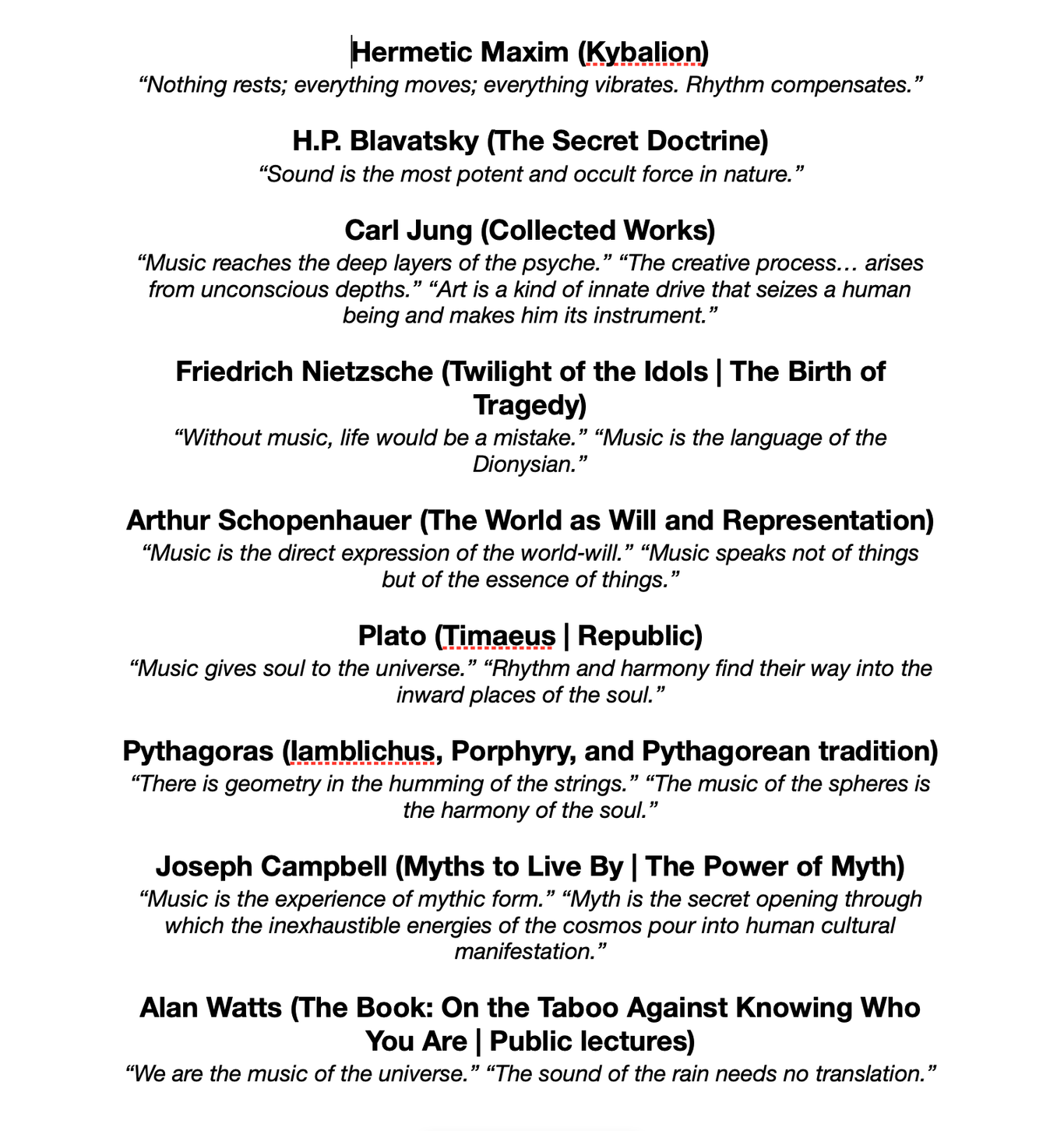
This page explores the metaphysical doctrine of music through the major traditions that shaped Western esotericism.
🌌 Core Themes
- Vibration — the Hermetic foundation of reality
- Harmony — the structure of the soul
- Unconscious Expression — Jung’s depth psychology
- Mythic Memory — Campbell’s mythic resonance
- Cosmic Music — Pythagorean and Platonic doctrine
- Occult Sound — Blavatsky’s astral vibration
- Consciousness Vibration — Watts’ experiential mysticism
🜁 Hermeticism
- Hermetic texts describe the universe as harmonic structure:
- Corpus Hermeticum X — all things are unified through harmony
- Corpus Hermeticum XIII — the soul is a harmony
- Asclepius — nothing moves without rhythm
- Kybalion — nothing rests; everything vibrates; rhythm compensates
Hermetic Doctrine: Music is the first expression of the divine Logos. Vibration is the architecture of reality. Rhythm governs all cycles.
🔥 Theosophy & Blavatsky
- Blavatsky frames sound as the engine of occult physics:
- The Secret Doctrine — sound is the most potent occult force
- Esoteric Instructions — vibration awakens memory in the astral light
Theosophical Doctrine: Sound is the strongest and most mysterious force in nature. Music activates astral memory. The soul responds to sound because sound is its own nature.
🧠 Jung & Depth Psychology
Jung sees music as the voice of the unconscious:
- music reaches deep layers of the psyche
- creativity arises from unconscious depths
- art seizes the human being and makes him its instrument
Jungian Doctrine: Music is the psyche remembering itself. Music is the unconscious speaking in symbolic form.
⚡ Nietzsche & Schopenhauer
Nietzsche:
- music is the primal force of life
- music is the language of the Dionysian
Schopenhauer:
- music expresses the world‑will
- music reveals the essence of reality
Doctrine: Music is the primal engine of existence. Music expresses reality before thought can.
🏛️ Plato & Pythagoras
Plato:
- rhythm and harmony shape the soul
Pythagoras:
- geometry lives in the strings
- cosmic harmony is the soul’s structure
Doctrine: Music shapes the soul. Music mirrors cosmic order. Music is the mathematical memory of the universe.
🌌 Campbell & Watts
Campbell:
- myth is the opening through which cosmic energies enter culture
- music is mythic form in motion
Watts:
- we are the music of the universe
- pure sound needs no translation
Doctrine: Music is mythic memory. Music is consciousness vibrating. Music is identity in motion.
🎤 Why Certain Songs Feel Haunting
When a song feels like:
- remembering
- haunting
- surfacing
- revealing
- speaking from the unconscious
- exposing what the ego tried to bury
…it is because the song is activating:
- Hermetic vibration
- Blavatskian astral memory
- Jungian unconscious content
- Pythagorean harmony
- Campbellian mythic structure
This is why a song like Jane Doe by Within Temptation feels like:
- a memory returning
- a shadow speaking
- a buried truth resurfacing
- an archetype haunting the narrator
The song is not just music — it is psyche in motion.
📘 Sources
- Corpus Hermeticum (CH I, X, XIII)
- Asclepius
- The Kybalion
- H.P. Blavatsky — The Secret Doctrine, Collected Writings
- C.G. Jung — Collected Works
- Nietzsche — Twilight of the Idols, The Birth of Tragedy
- Schopenhauer — The World as Will and Representation
- Plato — Republic, Timaeus
- Pythagorean fragments (Iamblichus, Porphyry)
- Joseph Campbell — The Power of Myth, Myths to Live By
- Alan Watts — The Book, public lectures