The Unfiltered Visions of Carl Jung: A Near‑Death Glimpse Beyond Time
Lark Lauren 9.22.2005
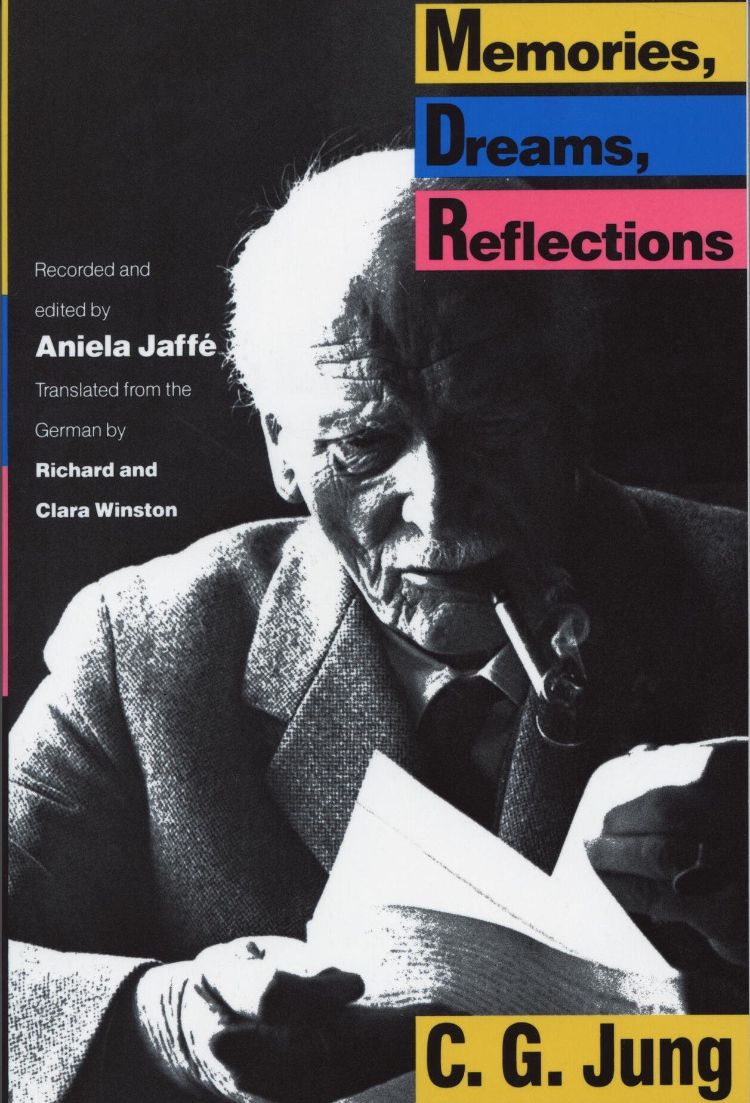
Carl Jung’s near‑death experience in 1944 remains one of the most quietly powerful episodes in his entire body of work. It sits in the margins of his public legacy, overshadowed by the familiar architecture of archetypes, dreams, symbols, and clinical insights. Yet in the pages of Memories, Dreams, Reflections, Jung finally speaks without the interpretive filter he maintained throughout his career. What emerges is a testimony of non‑duality, oneness, and timelessness that reshapes how we understand the man behind the psychology. These visions were not theoretical constructions but were lived realities that left permanent marks on his perception of the world.
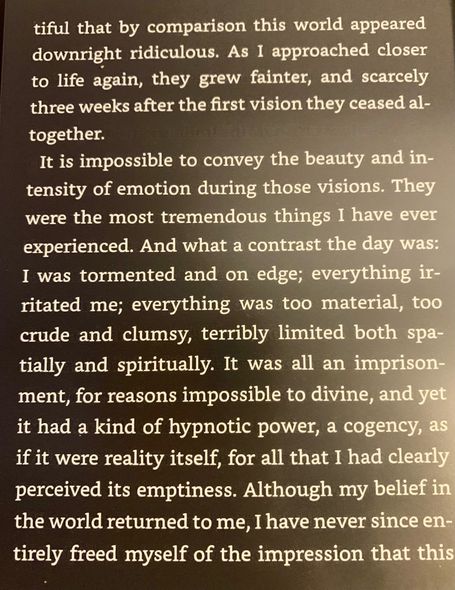
During the crisis of 1944, when he suffered a heart attack, Jung entered a state so beautiful and emotionally immense that ordinary life seemed crude by comparison. He writes that the world he returned to felt material in the worst sense of the word: heavy, clumsy, spiritually confined. The contrast was unbearable. Everything irritated him. Everything felt limited. He describes the physical world as an imprisonment whose reasons could not be divined, yet whose hypnotic power made it appear real despite its emptiness. Even after his belief in the world returned, he admits he never fully escaped the impression that something essential had been revealed and could not be forgotten. This is not metaphor. It is the phenomenology of someone who has seen beyond the veil and cannot pretend otherwise.
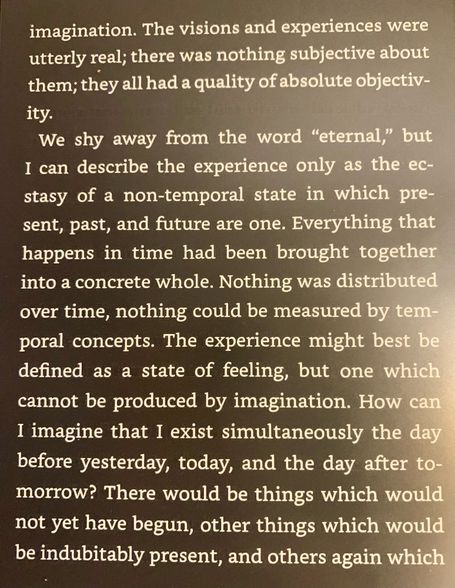
Jung insists that the visions were utterly real. They carried a quality of absolute objectivity, a clarity that imagination could never produce. This is striking because Jung rarely used the word “objective” lightly. Here, he uses it to describe experiences that transcend psychological categories. These were not symbolic projections of inner states. They were encounters with a reality that felt more concrete than waking life. In this unfiltered moment, Jung steps outside the boundaries of his own discipline and speaks from the interior of direct experience.
One of the most profound aspects of the NDE is his description of a non‑temporal state. Jung writes that past, present, and future existed as one. Nothing was distributed over time. Nothing could be measured by temporal concepts. Everything that happens in time was gathered into a single whole. He calls it an ecstasy, but not emotional ecstasy but a metaphysical ecstasy. It is a moment of pure non‑duality, where the linear sequence of existence dissolves and reveals itself as a unified field. Jung does not theorize this. He reports it, describes it, cherises it. And in doing so, he aligns with mystical traditions across cultures without ever intending to.
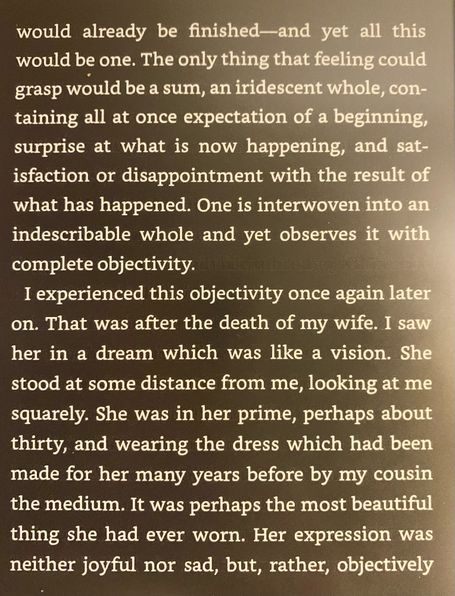
In this timeless state, feeling becomes an iridescent whole. Expectation, surprise, satisfaction, disappointment - everything is present at once, woven together and observed with complete objectivity. Emotion loses its personal character and becomes a total field of experience. This is a mode of perception that dissolves the ego’s temporal sequencing and reveals the structure beneath it. Jung’s language here is not analytical but experiential. He is describing what it is like to perceive without the boundaries of time.
Years later, after the death of his wife Emma in 1955, Jung encounters the same objectivity again. In a dream‑vision, she appears in her prime, wearing a dress made long ago, looking at him directly. Her expression is neither joyful nor sad. It is neutral in a way that transcends emotion. Jung recognizes the quality immediately. It is the same clarity he experienced near death. The same timelessness and the same dissolution of personal feeling into a larger field. This second encounter confirms that the NDE was not a hallucination but a mode of perception that could return under conditions of deep psychic rupture.
The Visions chapter matters because it reveals Jung without the public filter. Throughout his life, he moderated his language so people would not think he was too unconventional or outside the acceptable frame. He knew the world was not ready for the full extent of his experiences. Memories, Dreams, Reflections was published after his death, and you can feel the difference. He no longer cared about criticism. He no longer needed to protect his reputation. He allowed the deeper truth to surface.
This chapter is often ignored because it challenges the boundary between psychology and mysticism. It contradicts the image of Jung as purely a scientist. It shows him as someone who encountered states of consciousness that defy academic categories. It is the closest thing we have to Jung speaking from his deepest interior reality. And it is precisely this unfiltered honesty that makes the chapter essential for understanding the man behind the theories.
This morning, the sight of fallen leaves struck me - the sheer amount of them, the quiet accumulation that goes unnoticed in the city. It felt like a reminder of the same thinning of the veil Jung describes. Moments when the world reveals its fragility and something larger presses through. His visions are not distant historical curiosities. They are part of a continuum of human experience that still touches us in subtle ways, in quiet mornings, in unexpected clarity, in the sense that reality is both more and less than it appears.