The Unbroken Song: Why Lark Lauren - On Split the Lark, Creative Autonomy, and the Roots of Identity
Lark Lauren 08.30.2026
There is a quiet brutality in the human desire to dissect what we admire. Faced with pure expression, whether in art, spirit, or consciousness, the analytical mind often reaches for a scalpel, operating under the delusion that if it cuts deeply enough, it will find the mechanism of the miracle.
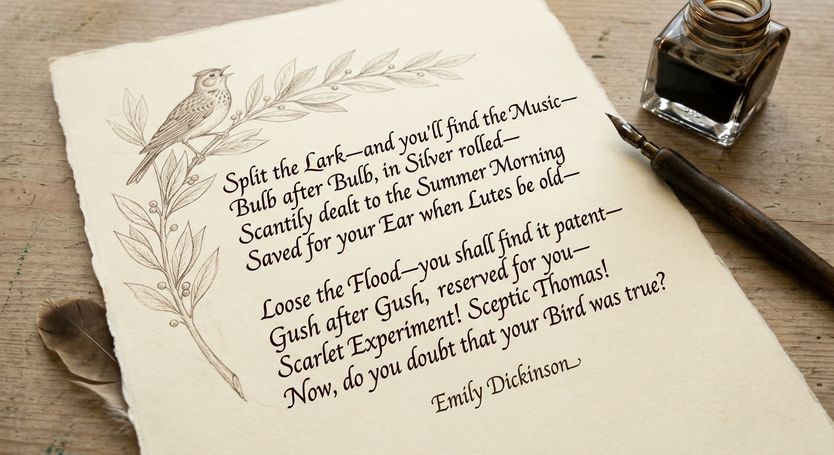
Emily Dickinson addressed this impulse directly in poem #861:
Split the Lark — and you’ll find the Music —
Bulb after Bulb, in Silver rolled —
Scantily dealt to the Summer Morning
Saved for your Ear when Lutes be old —
Loose the Flood — you shall find it patent —
Gush after Gush, reserved for you —
Scarlet Experiment! Sceptic Thomas!
Now, do you doubt that your Bird was true?
The Pathology of Dissection
Dickinson opens with a command that functions as a sarcastic taunt. To "split the lark" to locate the music is a physical impossibility; cutting open the songbird reveals no notes, only organs, blood, and silence.
The imagery in the second stanza shifts to the consequences of this analytical arrogance. When the skeptic "looses the flood," expecting a neat formula or proof, they receive instead a "gush after gush"—the gruesome evidence of a destroyed source. The reference to "Sceptic Thomas" evokes the biblical disciple who demanded physical, tactile proof before he would believe.
In Dickinson’s view, the skeptic who demands empirical dissection before honoring creative or spiritual truth ends up with a "Scarlet Experiment"—a ruined medium and no music left to hear.
The Synthesis of Identity: Lark and Lauren
This tension between expression and dissection is central to creative autonomy. Real work does not exist to justify itself under a microscope, nor does it yield its essence to those who demand proof over resonance. It requires a framework that protects the primary spark while remaining grounded in real substance.
That balance forms the architecture behind the identity Lark Lauren:
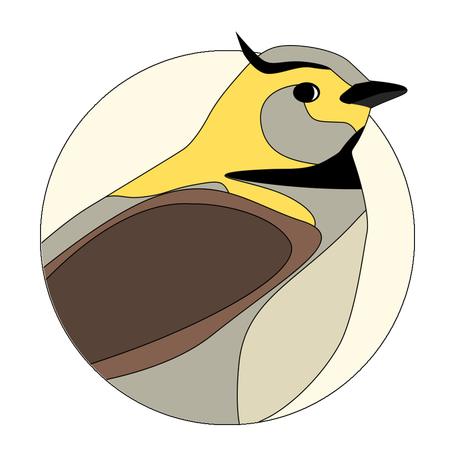
- Lark: The soaring, primary channel of expression. It represents the song born of direct perception, elevated vision, and uncompromised creative autonomy—a voice that sings from higher ground without needing to dissect itself for external validation.
- Lauren: Rooted in the Latin Laurentius (meaning "from the sanctuary of the laurel grove"), it represents grounded wisdom, enduring craftsmanship, and victory achieved through quiet mastery. It is the soil, the lineage, and the personal truth from which the song emerges.
Keeping the Song Intact
To create from a place of strategic and spiritual autonomy means resisting the pressure to reduce living art into cold mechanics. The music of a work is never found in its vivisection; it lives in the unbroken synthesis of vision and voice.
True creative work and inner truth are not meant to be picked apart, over-analyzed, or forced into external molds. They are meant to be experienced. Lark is the symbol of unfiltered, authentic perception and experience.
The task of the artist is not to satisfy the skeptic’s demand for proof. The task is to preserve the source, honor the roots, and keep the song intact. It's about honoring the unseen spark and protecting the integrity of the inner voice.