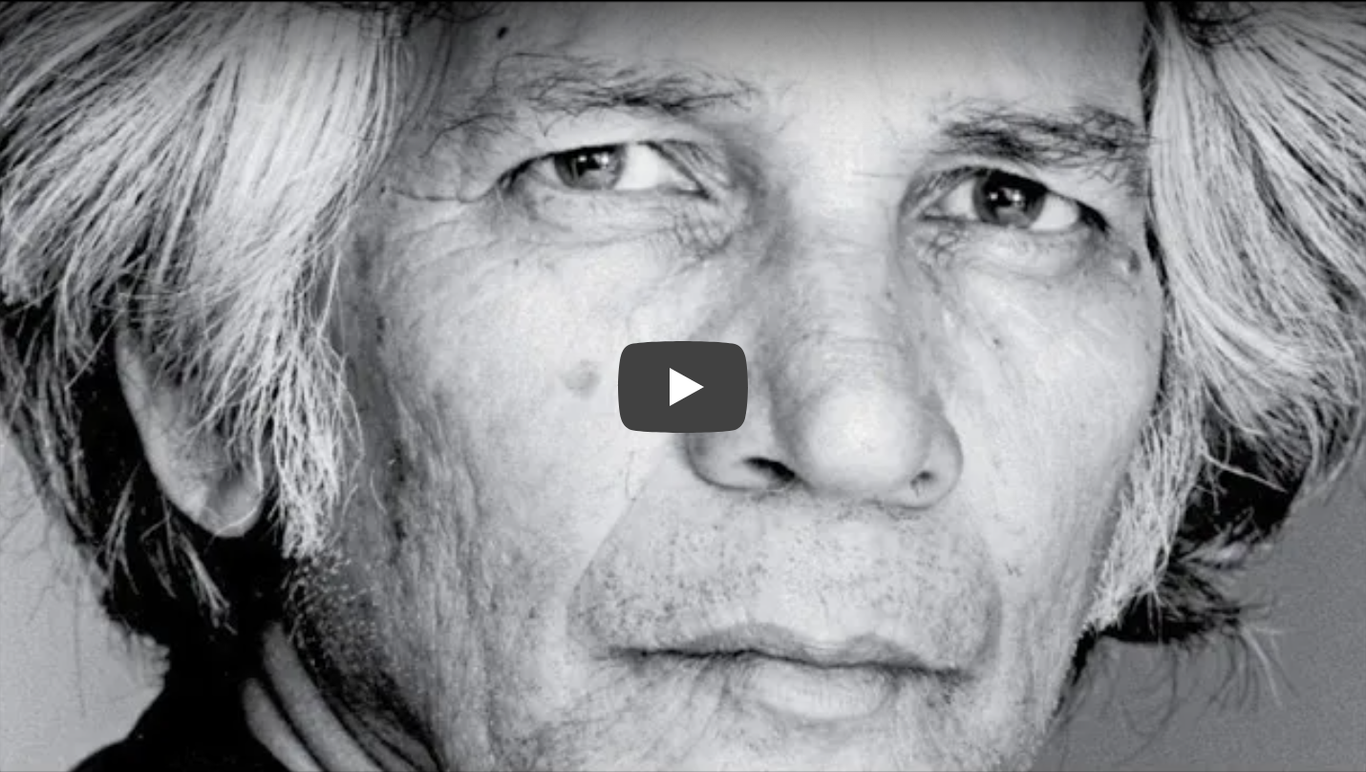
U.G. Krishnamurti: The Unguru Who Wanted to Vanish
Lark Lauren 9.5.2026
U.G. Krishnamurti remains one of the most unsettling figures in modern spiritual history, not because he offered a new teaching, but because he insisted that no teaching is possible. His life moved through the same esoteric paths that shaped the early twentieth century - Theosophy, J. Krishnamurti’s circles, the psychological revolution of the era - yet he emerged from all of them with a message so stark that it dismantled the entire architecture of spiritual seeking. He is often called the unguru, the one who refused the role, refused the authority, and refused the legacy. And yet, paradoxically, his presence survives in videos he never wanted recorded.
In his youth, U.G. came into contact with Theosophical circles, absorbing the vocabulary of occult evolution, inner planes, and metaphysical development. Theosophy offered a grand symbolic map of human transformation, a cosmology of ascent and refinement. But instead of adopting this map, U.G. eventually turned it inside out. He saw in Theosophy the same fundamental problem he would later identify everywhere: the human mind’s compulsive need to escape itself through meaning, symbolism, and metaphysical promise. Theosophy’s architecture was vast, but for U.G., it was still architecture, still construction, still conditioning, still an attempt to improve the seeker rather than dissolve the seeking.
U.G. Krishnamurti’s early exposure to the Theosophical Society brought him into indirect contact with C.W. Leadbeater, who was still a dominant influence in the organization during U.G.’s childhood. Leadbeater represented the height of Theosophical authority: clairvoyant claims, occult hierarchies, initiatory structures, and the grooming of spiritually “advanced” individuals. U.G. witnessed this atmosphere from the inside through his grandfather’s involvement, absorbing the language and symbolism that shaped the movement. But instead of being inspired by Leadbeater’s elaborate metaphysical system, U.G. became increasingly disillusioned with the entire structure. Leadbeater’s world of astral planes, spiritual progress, and clairvoyant insight became, for U.G., the perfect example of how the human mind constructs meaning to escape the raw fact of existence. This early intersection mattered because it planted U.G. directly inside the machinery he would later reject so completely, shaping the radical stance that would define him as the unguru who dismantled every spiritual narrative he once observed up close.
His encounters with J. Krishnamurti were equally formative. Both men rejected organized religion and spiritual authority, but their temperaments diverged sharply. J. Krishnamurti dismantled tradition with surgical clarity, offering insight into the nature of thought, conditioning, and freedom. U.G. went further, stripping away even the subtle comfort of insight. Their meetings were intense, sometimes confrontational, always charged with the tension between two men who saw the same illusion but responded to it differently. J. Krishnamurti still believed in the possibility of understanding. U.G. believed that even understanding was part of the trap. Where J. Krishnamurti spoke of “truth as a pathless land,” U.G. insisted that even the idea of truth was another movement of the conditioned mind.
If U.G. had ever met C.G. Jung, the encounter would have been confrontational in the deepest philosophical sense. Jung built an entire psychological architecture around meaning, symbol, archetype, and inner development. He believed the psyche was structured, symbolic, and oriented toward individuation. U.G. rejected every symbolic system, every psychological map, and every attempt to interpret human experience. Jung would have spoken of the Self; U.G. would have denied the seeker. Jung would have explored symbols; U.G. would have burned the symbols down. Jung would have described transformation; U.G. would have called it conditioning. Their foundations were incompatible, and the meeting - had it occurred - would have been a collision of two brilliant minds inhabiting entirely different universes.
U.G.’s life itself was tumultuous. He wandered through poverty, failed relationships, illness, and existential collapse. He described a dramatic event he called “the calamity”, a biological shift that occurred on his forty-ninth birthday. He insisted it had no spiritual meaning, no mystical significance, and no method behind it. It was not the result of practice, discipline, meditation, or belief. It was simply an acausal transformation back to what he called “the natural state.” He refused to call it enlightenment, refused to interpret it, refused to allow others to interpret it. For him, the entire spiritual project—every path, every technique, every metaphysical system—was built on illusion and fueled by human insecurity.
This stance places U.G. in proximity to the radical non-duality of figures like Jim Newman and Tony Parsons, who insist that there is no path, no seeker, no practice, and no attainment. Their message is uncompromising: nothing needs to happen, nothing can be achieved, and the search itself is the barrier. But U.G.’s version is even more severe. Newman and Parsons still speak in the language of “the message.” U.G. rejected even the idea of a message. He refused to offer comfort, insight, or metaphysical coherence. He refused to be remembered. He refused to be a teacher. He refused to be a guide. He refused every role the spiritual world tried to place upon him.
And yet, paradoxically, his presence survives in videos he never wanted recorded, including conversations like the one preserved here: https://youtu.be/-Qc52rgXeWI
People recorded him anyway. They kept the tapes, digitized them, uploaded them, shared them on platforms like YouTube. His refusal became part of the fascination. The man who wanted to vanish became impossible to erase. His presence survives in grainy footage, in conversations captured against his wishes, in the stark clarity of a message that denies its own existence. He wanted no legacy, but the legacy formed around the very refusal.
U.G. Krishnamurti stands as a paradox: a figure who rejected every spiritual narrative, yet whose rejection became one of the most radical narratives of the modern spiritual world. Not a teacher, not a mystic, not a philosopher - an unguru whose life became a mirror held up to the entire machinery of seeking. In that mirror, many find a strange clarity: not a path forward, but the collapse of the need for one.