The Story Carries the Person: Burnout, Pneuma, and the Problem of Recursive Thought
Lark Lauren 10.7.2026
Burnout is conventionally framed as a failure of physical capacity, a simple equation of excessive hours, relentless obligations, and unchecked modern velocity. Yet a closer, sustained observation of human exhaustion suggests that sheer physical and mental overload is rarely the root cause. Many individuals navigate grueling hours and high stakes with sustained vitality, while others sink into profound apathy under relatively modest demands. This divergence suggests that burnout may arise from a deeper process operating beneath conscious awareness. It begins long before the physical organism protests, often at the very moment an individual enters a pursuit, whether a career, a relationship, an esoteric tradition, a philosophical framework, or a personal ambition, and constructs a narrative around it. Initially, the narrative serves as a useful guide, but over time it accumulates layers of justification, anxiety, future expectations, social validation, and self-definition until a critical tipping point is reached where the person no longer carries the story, but the story carries the person.
The process becomes recursive. One thought generates a defensive thought, one conclusion demands a broader conclusion, and one identity creates an auxiliary identity to protect itself. The mind enters a closed system of self-reference, continually feeding on its own momentum while the original purpose recedes into the background. This mechanism mirrors optimization algorithms in artificial intelligence, where a system tasked with refining a process gradually begins optimizing the optimization itself, drifting away from its foundational purpose until it arrives at results that are technically sophisticated yet fundamentally disconnected from the reason the process began. Human beings frequently mirror this same pattern when they embark on self-improvement, improve the methodology of self-improvement, and eventually manage the meta-system that monitors that methodology. Direct living is gradually replaced by the full-time administration of an ever-expanding apparatus of psychological self-reference, making burnout the physiological and spiritual weight of carrying too many recursive loops simultaneously.
Recognizing these loops reveals the radical nature of iconoclastic figures like U.G. Krishnamurti, whose work largely centered on the interruption of human narratives, especially spiritual, psychological, and existential ones. He targeted the machinery of becoming itself, exposing how even the quest for enlightenment can become another loop designed to perpetuate the seeker’s identity. Yet an equally important pattern emerges when observing the aftermath of such interruptions. Every disruption can itself be absorbed into another narrative. The ego is remarkably adaptive, capable of adopting almost any costume: saint, mystic, rationalist, skeptic, rebel, critic, or jaded observer. When a person recognizes the limitations of a belief system, the mind often pivots from naïve identification to cynical detachment, becoming guarded and emotionally distant as expectations collapse beneath repeated disappointment. The danger is that cynicism frequently masquerades as wisdom. A tired mind appears lucid, a disappointed mind appears detached, and a hardened mind appears enlightened. In reality, the individual may have only exchanged a positive loop for a negative one, leaving the underlying machinery fully intact.
Where intellectual analysis struggles to interrupt recursion, intentional art and sonic geometry can sometimes create a different type of break. This possibility is one reason Tool’s Pneuma remains so compelling. Derived from the ancient Greek word for breath, spirit, or animating force, Pneuma points toward the living principle inhabiting the soma, the physical body. Comparable, though not identical, concepts appear in other traditions, such as Kundalini in Yoga and Shakti-based systems. Some listeners have noted parallels between the song’s structure and Kabbalistic models of ascent through the Sefirot, interpreting the composition as a symbolic movement of descent and return.
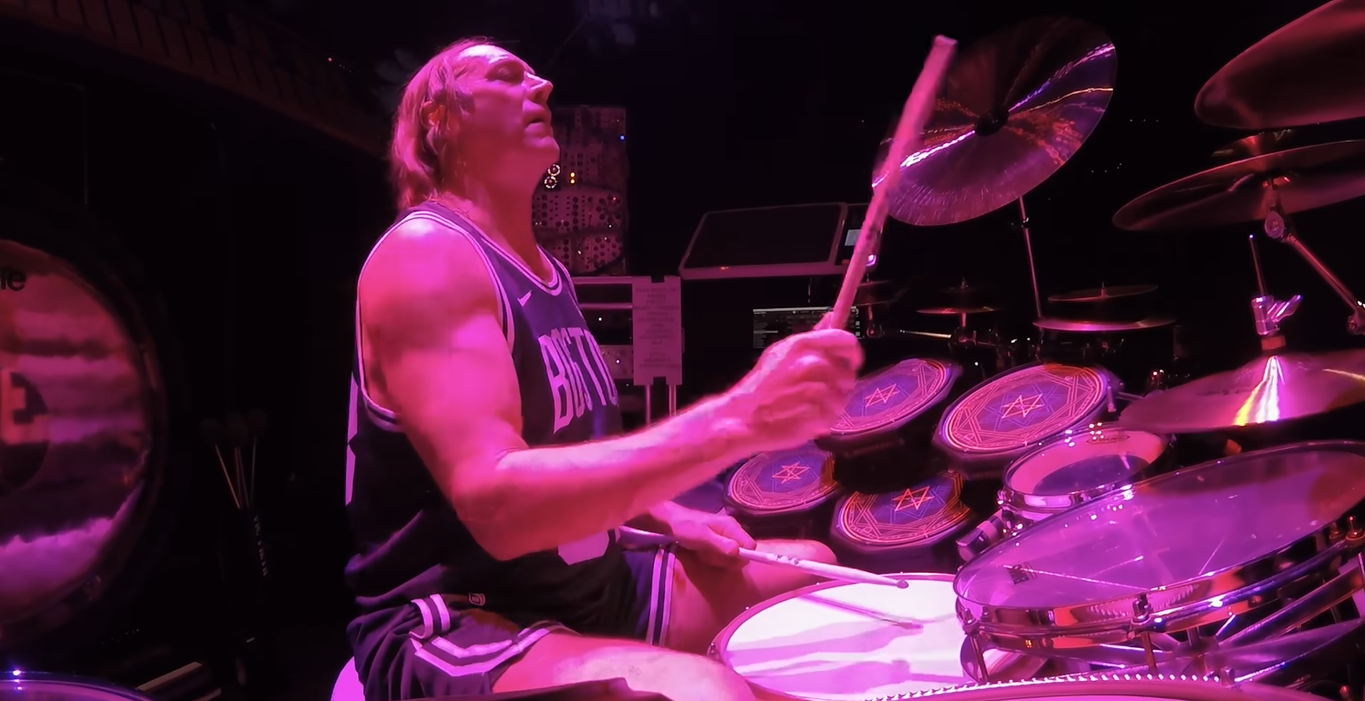
As technical drum analyses demonstrate, the song’s rhythmic engine relies on a recurring phrase of 33 beats, structured through shifting bars of 12/8, 11/8, and 10/8. Readers familiar with Qabalistic symbolism may notice an intriguing parallel with the 32 Paths of Wisdom and Da’at, the hidden sphere associated with knowledge beyond ordinary conceptual understanding. Whether intentional or coincidental, the correspondence offers a compelling symbolic lens through which to view the composition. Danny Carey’s hybrid drum apparatus incorporates geometric symmetry, custom Mandala pads, and design elements reflecting his long-standing interest in sacred geometry and esoteric symbolism. Likewise, the lyrical imagery lends itself to a reading that resembles ascent through the Tree of Life, beginning with embodiment and culminating in remembrance of a more universal spiritual identity.
At this junction, however, the analytical mind encounters its greatest trap. It is entirely possible to memorize the 33-beat subdivisions, map every time signature, calculate the polyrhythmic ratios, and construct elaborate Kabbalistic diagrams. Yet doing so may simply redirect the recursive loop into a different space. This paradox was captured by Emily Dickinson in her poem Split the Lark, where she observed that cutting open the songbird to discover the source of its music yields only blood, tissue, and silence. The mechanics do not contain the living music; they merely provide the vessel through which the music moves. In much the same way, dissecting Pneuma through pure intellect can anchor consciousness in Hod, the intellectual sphere of analysis, leaving the listener holding elegant structural equations while the living experience slips away. The overlapping polyrhythms are frequently described by listeners as immersive and disorienting, creating an experience in which analytical tracking gradually gives way to direct sensation.
The primary key to escaping the recursive loops of burnout, over-analysis, and psychological fatigue may be a form of non-conceptual awareness. When a person listens to the polyrhythmic geometry of Pneuma without attempting to count it, analyze it, or reduce it to a diagram, the mind is temporarily displaced from its habitual self-referential tracking. The music functions as a catalyst, clearing internal noise and revealing a quieter layer of experience beneath it. This may help explain the intense emotional resonance often reported within the community of listeners surrounding the song. Many describe a sense of isolation, yet also a simultaneous recognition that others have encountered the same condition. Such isolation may arise when older psychological narratives begin losing their grip. As familiar stories lose their ability to organize experience, a period of solitude often follows, creating a space in which new forms of perception become possible.
Moments of authentic presence are rarely dramatic achievements. They do not add more knowledge, more systems, or more self-improvement. Instead, they appear as brief pauses in which the constant movement of defending, explaining, promoting, interpreting, and analyzing falls silent. In such moments, the observer begins to recognize that the analyst and the pattern being analyzed are not separate. The realization brings humility rather than triumph. The machinery becomes visible, not as something belonging to others, but as something operating within oneself.
When the urge to dissect the lark is relinquished, the living song returns. Burnout, cynicism, spiritual seeking, and intellectual over-analysis begin to reveal themselves as different expressions of the same recursive tendency of mind to secure and perpetuate itself through narrative. By dropping the story and stepping into direct, non-conceptual experience, the individual ceases managing a self-referential system and begins participating more fully in life as it is. In that opening, the breath of Pneuma may be felt more directly, not as a doctrine or theory, but as a living presence, opening the possibility of a deeper participation in the field of experience that so many philosophical, mystical, and spiritual traditions have attempted to describe.
TOOL - "Pneuma" Live Drum Cam (Danny Carey)
Questions Beyond the Story
If burnout is the exhaustion of carrying a story, then an uncomfortable possibility emerges: perhaps the problem is not only the story itself, but the one who continually returns to manage it. Every attempt to improve the narrative, escape the narrative, or detach from the narrative may become another chapter within the same recursive process.
Many spiritual, philosophical, and psychological traditions have approached this problem from different directions. Figures such as U.G. Krishnamurti and Adi Da Samraj challenged the assumption that freedom is found through endless self-improvement or the construction of a more refined identity. Instead, they pointed toward a more fundamental inquiry, one aimed not merely at action, but at the actor itself.
The question "Why am I doing this?" interrupts the momentum of habit. It challenges the assumptions hidden beneath ambition, obligation, duty, and desire. It asks whether an action arises from a living impulse in the present moment or from the accumulated inertia of an old psychological agreement.
The question "Who am I?" moves deeper. Rather than examining the action, it examines the one claiming ownership of the action. When pursued sincerely, it begins dissolving the identities created to define, protect, or justify oneself. The worker, the seeker, the intellectual, the healer, the victim, the success story, the failure story, and even the observer itself all come into view as possible constructions.
Yet another paradox appears here. If detachment from the persona becomes a goal, has the mind simply created a new identity for itself, that of "the detached one"? The worker becomes the seeker, the seeker becomes the observer, and the observer risks becoming a distant and cynical bystander. The recursive machinery survives by changing costumes.
At the same time, recognizing that identity is constructed does not necessarily require the conclusion that individuality is meaningless. The discovery that the self is partly narrative does not automatically imply that there is nobody present. Something still experiences, chooses, suffers, desires, loves, grieves, and asks these questions. The challenge may not be to deny the self, but to distinguish between the living reality of experience and the stories through which that experience is interpreted.
A practical entry point into this distinction lies in how we manage our everyday societal roles, particularly the identity we assume at work. When we tamper with our rigid identification with the workplace persona by deliberately treating it as a functional uniform rather than our core self, the psychological weight of the job shifts. By strictly adhering to designated working hours and consciously refusing to bring that professional persona home, we create a vital containment zone. This boundary prevents the professional narrative from expanding into a full-time mental tyranny. Without the continuous fuel of after-hours rumination, the recursive loop of work-related anxiety is starved of energy. Consequently, burnout is either significantly blunted in its intensity or prevented from taking root entirely, simply because the persona is laid down before it can exhaust the person.
Perhaps detachment is not the final answer. A mask is not inherently a problem. Human beings require roles, names, professions, relationships, and stories to function in the world. Burnout may arise not from possessing a persona, but from forgetting that it is a persona. The issue is not the mask itself, but unconscious identification with it.
This suggests a shift from detachment to recognition. Recognition does not require force. It does not attempt to destroy the story or escape the world. Instead, it simply sees the story for what it is: a useful instrument rather than an absolute identity. In that recognition, the energy once spent defending, maintaining, optimizing, and repairing the narrative may no longer be necessary. Likewise, desires, preferences, fears, and aspirations need not be treated as enemies to be eradicated, but as aspects of experience to be understood rather than obeyed blindly.
The ancient idea of Pneuma, the living breath or animating presence beneath conceptual thought, points toward this possibility. Not withdrawal from life, but participation without complete identification. Not becoming nobody, but remembering that no single story can fully contain what one is. The persona remains, the responsibilities remain, and life remains, but they are no longer mistaken for the entirety of the one who carries them.